

I came across a great analogy from Stephen Russell about DeepSeek and it got me thinking about this tool and why it has been so impactful. I will not focus on the geopolitical elements or the economic ones. I will not even focus on the fact that it’s open source (or more precisely open weights) and what it means for adoption. I want to focus on the very simple design decision they made of showing the chain of thought reasoning as part of the chatbot window.
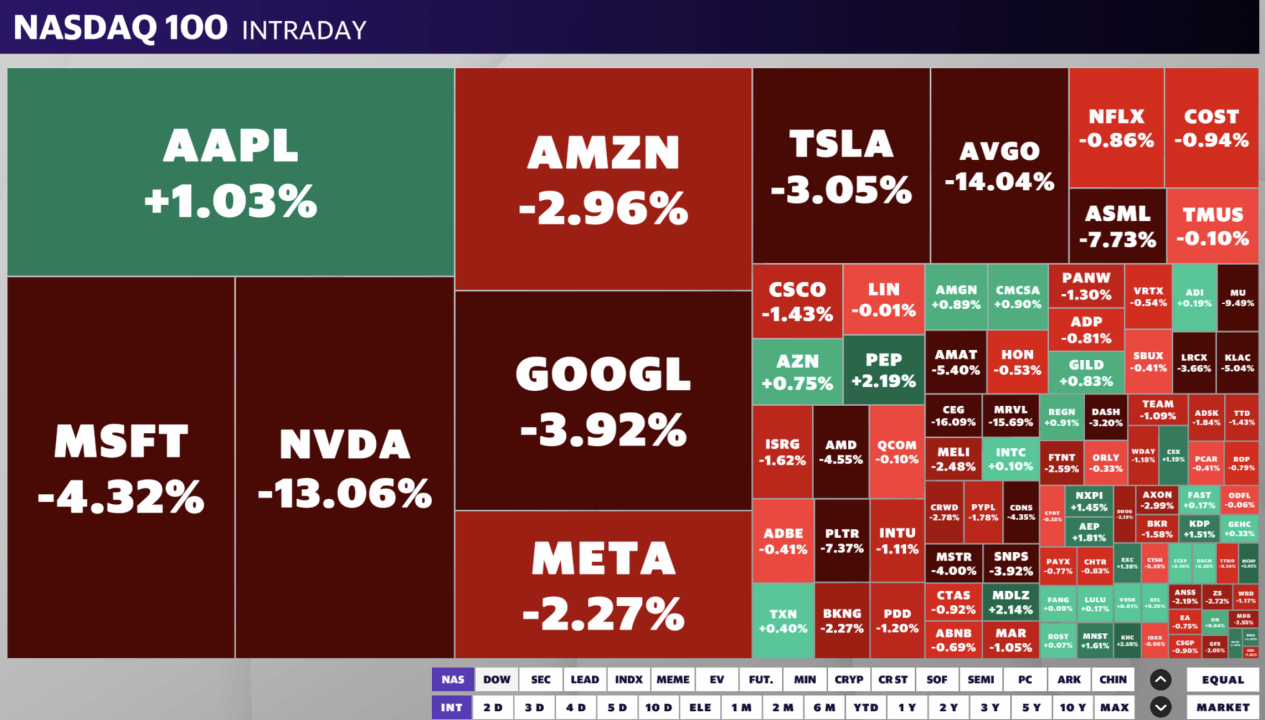
Market carnage following DeepSeek release
DeepSeek is a ‘reasoning’ LLM, which is an approach introduced via OpenAI models o1 and o3. I have never interacted with these models, but the concept is that when prompted, they take some time to ‘reason’ before providing the answer. This allows them to backtrack and ‘think’ beyond just predicting the next token. The breakthrough was based on the chain of thought (CoT) approach which is a technique used by most prompt engineers to get the most out of LLMs.
This innovation was released by OpenAI in September 2024 and I read many articles and saw many videos about it. It was very impressive although it always felt a little frustrating not to know what was happening when the model was ‘reasoning’; in some instances, for over 2-3 minutes consuming expensive tokens! Open AI justified their decision not to show the chain of thought using a mix of safety concerns, competitive advantage and monitoring reliability. I was a bit more skeptical, and I thought it would allow OpenAI to apply a secret sauce charge which could give them a handy revenue stream. At the end of the day, from a user perspective, if the answer is great, why do we need to know how the model arrived at it?
I thought I would just have to wait for this approach to become mainstream before I could get my hands on a ‘reasoning’ model. But then DeepSeek appeared and changed everything. Not only was I now able to play with a much more capable tool, I could see how it ‘reasons’ to arrive at its answer, peek inside the black box, get access to the secret sauce.
So, I decided to work on Stephen’s analogy with DeepSeek and follow its thinking. I decided to build up the answer by adding more factors as I went along and using the chain of thought to fine tune it. It was a completely different experience! Some of the frustrations I feel when prompting existing models, were reduced when I was able to understand the ‘reasoning’ and point out specifics where I wanted tweaks introduced. I think most AI companies will replicate this approach as it allows users to read the LLM’s ‘mind’ and not only gain superpowers, but get better results too.

DeepSeek doing some thinking…
This is what it came up with following 3 prompts from me and a lot of its own reasoning:
The AI Kitchen Analogy: Closed vs. Open Weights vs. Open Source
1. ChatGPT (Closed Source):
Imagine a luxury restaurant with a secret menu. The chefs (developers) craft exquisite dishes (answers), but the kitchen is strictly off-limits. You can’t see the recipes, tweak the ingredients, or learn their techniques—it’s all proprietary. You get a polished meal, but you’re entirely dependent on the restaurant’s rules and creativity. “Trust us, it’s delicious!”2. DeepSeek (Open Weights):
This is like a food truck that shares its ingredient ratios. You get the exact measurements for their signature sauce (model weights), but not the step-by-step cooking instructions, prep secrets, or training data. Skilled cooks can reverse-engineer or adapt the recipe, but it’s not fully transparent. “Here’s the blueprint—experiment if you dare!”3. Llama (Open Source):
Picture a crowdsourced cookbook with a public test kitchen. Every recipe (code), ingredient (training data), and technique (model architecture) is shared openly. Home cooks can not only replicate the dishes but also tweak the spices, swap proteins, or even rebuild the oven (modify the framework). Collaboration is the goal: “Improve this recipe, share your version, and feed the community!”
Not too bad! However, I still prefer Stephen’s analogy which goes to the heart of why human creativity is not likely to be replaced anytime soon, That is for a different blog post. Maybe a joint one!
The next section shows the whole interaction in detail. It’s quite long but it’s worth reading to get a feel for it. I’ve tried to format it so it’s easy to follow what is happening. I love the internal turmoil when DeepSeek agonises over its answers and whether it is achieving its goals. I sometimes have an internal monologue, but it sounds nothing like this!
First prompt
What is the best way to explain the difference between ChatGPT and DeepSeek using a cooking analogy?
DeepSeek Chain of Thought
Okay, let’s see. The user wants a cooking analogy to explain the difference between ChatGPT and DeepSeek. Hmm, cooking analogies… I need to think of something that relates to how each AI works.
So, first, what do I know about ChatGPT and DeepSeek? ChatGPT is developed by OpenAI, right? It’s known for generating human-like text and is quite versatile in handling various topics. DeepSeek, if I recall correctly, is a Chinese AI that might be specialized in certain areas, maybe more focused on specific tasks or optimized for particular domains.
In a cooking analogy, maybe compare them to chefs. Let me start there. ChatGPT could be like a versatile chef who can make a wide range of dishes. But maybe DeepSeek is like a specialist chef, excelling in a particular cuisine. Wait, but I need to make sure that’s accurate. Alternatively, maybe the difference is in their training or approach. ChatGPT uses a large dataset and a transformer architecture, while DeepSeek might have some different architecture or optimization techniques.
Wait, the user probably wants a simple analogy that highlights their unique strengths. Let me think again. If ChatGPT is like a generalist chef who can cook many dishes but might not have the depth in some areas, whereas DeepSeek is like a chef who uses a unique cooking technique or specializes in a specific type of cuisine, making it more efficient or effective in that area.
Alternatively, maybe the difference is in how they’re trained. If ChatGPT is trained on a diverse dataset, like a chef who has learned from many different cuisines, DeepSeek might be trained with a specific method, like a chef who uses a particular cooking style or ingredient that makes their dishes distinct.
But I need to ensure the analogy is clear. Let me structure it step by step. First, define ChatGPT in the analogy. Then define DeepSeek. Maybe the key points are versatility vs. specialization, or approach to problem-solving.
Another angle: ChatGPT is like a chef who follows a well-known, broad recipe book, while DeepSeek uses a proprietary or specialized recipe that allows it to perform certain tasks better or faster. Or perhaps ChatGPT is like a home cook with a wide range of basic skills, and DeepSeek is a sous-vide expert, using precise techniques for specific results.
Wait, maybe the cooking techniques. For example, ChatGPT is like a chef using traditional methods to create a variety of dishes, while DeepSeek uses a modern, innovative technique that makes certain dishes more efficient or accurate. That could work.
But I need to check if there’s any specific technical difference between the two. Since DeepSeek might be optimized for certain tasks, maybe in reasoning or efficiency. So, in the analogy, ChatGPT is the versatile chef, and DeepSeek is the one with a specialized tool or method that gives an edge in specific areas.
Yes, that seems plausible. The user might want to highlight that both are competent but have different focuses. So, the analogy would be: ChatGPT is a versatile chef with a broad range, while DeepSeek is a specialist with unique techniques for certain dishes. That should make the difference clear.
Output
Cooking Analogy: ChatGPT vs. DeepSeek
ChatGPT is like a versatile master chef trained in countless global cuisines. They can whip up a broad menu—Italian pasta, Indian curry, French pastries—with creativity and adaptability. While they might not always perfect every dish, their strength lies in their ability to handle diverse requests, improvise with available ingredients, and explain complex recipes in simple terms. Think of them as the go-to for general cooking advice, experimentation, or casual conversation about food.
DeepSeek, on the other hand, is like a precision-focused specialist chef with a secret innovation. Imagine a sushi master who uses a uniquely sharp knife or a molecular gastronomy expert with a proprietary technique. They might prioritize efficiency, accuracy, or niche expertise (e.g., solving specific problems or optimizing tasks). Their dishes could be faster, more refined, or tailored to particular tastes, but they might not improvise as widely as the master chef.
Key Difference:
- ChatGPT = Jack-of-all-trades — great for general tasks, creativity, and broad knowledge.
- DeepSeek = Specialized tool — excels in targeted areas, optimized workflows, or niche domains.
Both are skilled, but their “kitchens” (approaches) are designed for different culinary missions!
Second prompt
This is good but I want to focus the analogy on DeepSeek being open source and ChatGPT being closed source
Quite a lot to digest here. I expect AI is about to get cheaper, better and faster. Why should I complain?

Arturo Dell


